Table Of Content
Remember that “students” is the subject of the generic learning outcome stem shown at the beginning of this section. The goals for your course should not be stated in terms of what the instructor will cover, but rather in how the students will change, facilitated by the instructor’s guidance. Six Common Planning Pitfalls – Recomendations for Novice Educators – This article looks at common mistakes made by novice teachers when planning lessons, including planning with no clear objective. Microlearning helps create more impactful learning through efficient, timely, and relevant experiences. Jean Pak is the founder and owner of Jean Pak LLC and a Thinkific Expert and Learning Experience Designer helping businesses develop more interactive and engaging learning experiences. In no time at all, you might see improvements in the performance of your students, the quality of your classes, and the ratings of your online lessons.
Stage Three – Plan Learning Experiences and Instruction:
The right backward design lesson plan may result in a better learning experience for a classroom full of students, a private client, and everyone in between. We’re going to break down what backward design lesson planning is and why you should use it. The primary starting point for backward design is to become familiar with the standards/outcomes for the grade level and curriculum being taught. The second part of curriculum planning with backward design is finding appropriate assessments. It can be difficult for "traditional" educators to switch to this model because it is hard to conceptualize an assessment before deciding on lessons and instruction.
Stage Two – Determine Acceptable Evidence:
If the teacher has explicitly defined the learning goals of the course, then they have a better idea of what they want the students to get out of learning activities. Furthermore, if done thoroughly, it eliminates the possibility of doing certain activities and tasks for the sake of doing them. Every task and piece of instruction has a purpose that fits in with the overarching goals and goals of the course. Your learning outcomes should be achievable for the students in your class and achievable in the time allotted to your subject.
Here's What It Takes To Fly a Model Plane Backwards - Popular Mechanics
Here's What It Takes To Fly a Model Plane Backwards.
Posted: Thu, 31 Mar 2016 07:00:00 GMT [source]
Using Backward Design to Plan Your Course
Ohio's license plate mistake depicts a plane flying backwards - NPR
Ohio's license plate mistake depicts a plane flying backwards.
Posted: Mon, 25 Oct 2021 07:00:00 GMT [source]
For the first time, it felt like none of my class was wasted; everything actually mattered. By beginning with the end in mind, teachers are able to avoid the common problem of planning forward from unit to another, only to find that in the end some students are prepared for the final assessment and others are not. Developed by Maria Montessori in the early 20th century, this method emphasizes student-directed learning in multi-age classrooms. In the Montessori approach, the teacher serves as a facilitator rather than a director of learning. Unlike Backward Design, which is highly structured around pre-set objectives and assessments, Montessori is far more exploratory and driven by the student's own interests. Dr. Benjamin Bloom, who created Bloom’s Taxonomy of learning objectives, often adhered to this method.
Related Teaching Topics
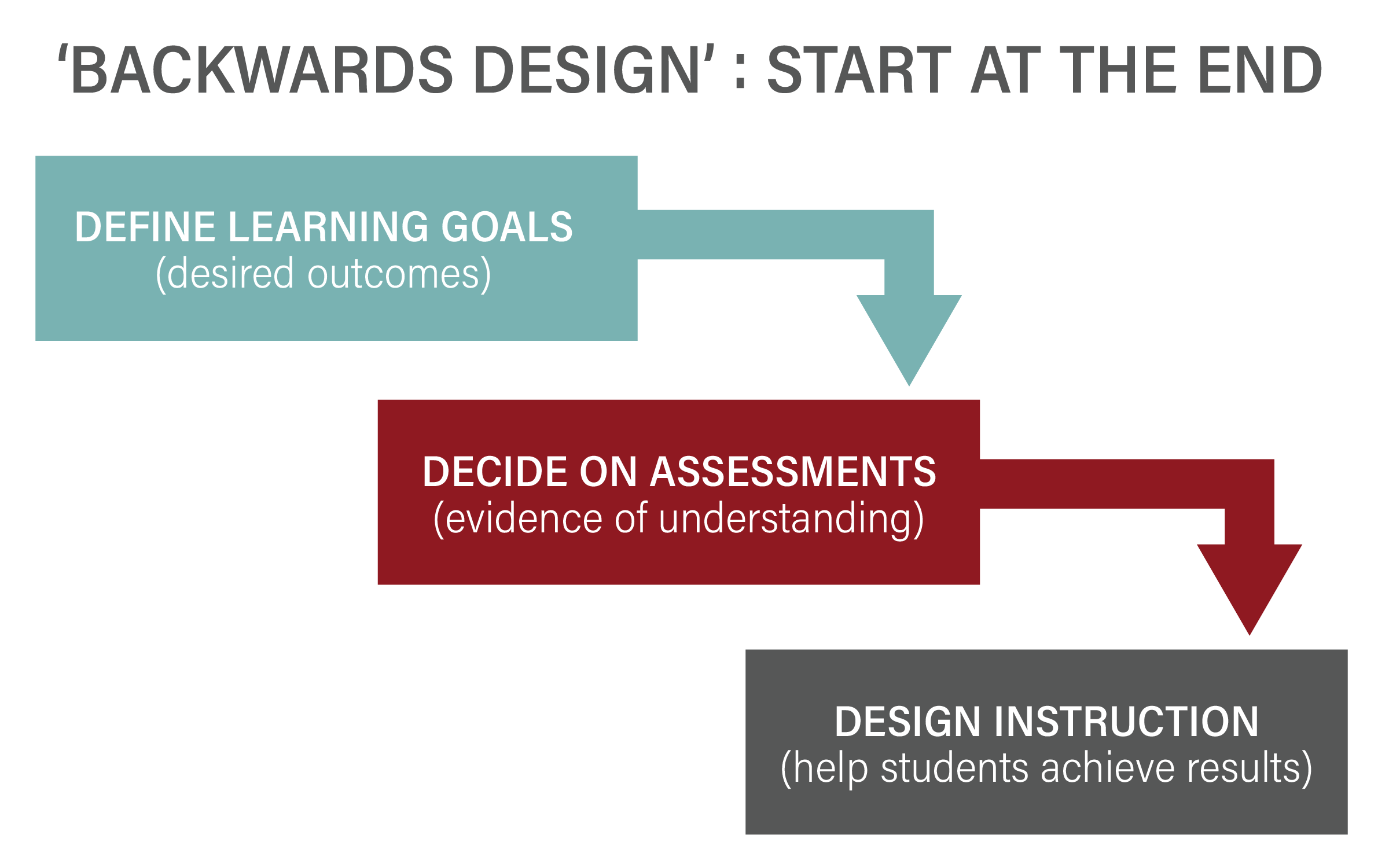
You might hear teachers asking, "What are the desired outcomes?" or "What evidence of learning will we accept?" These questions show that the influence of Backward Design is widespread and still growing. Backward Design is a planning framework in which you start with the end in mind - the desired outcomes. Once you have determined what you want the students to be able to know and do, you’ll define how you will know if the student has achieved those outcomes. In the well-known book The Seven Habits of Highly Effective People, author Dr. Stephen Covey describes seven habits that successful people tend to live by. The second habit is “Begin with the end in mind.” Dr. Covey was suggesting that the most successful people are those who create a vision of the future in their mind.
Flipped Classroom
Just like any plan, your initial Backward Design framework may require adjustments. Formative assessment expert Paul Black advocates for continuous improvement through the feedback loop, which involves tweaking the lesson plans based on student performance and other data. Teachers like Carol Ann Tomlinson, known for her work on differentiated instruction, have noted that when students understand what they're working towards, they are often more engaged and motivated. Backward Design’s focus on clear objectives and transparent assessments lets students know what's expected of them, which can enhance their motivation to succeed.
Set aside specific content—remember, that comes toward the end of the backward design process—and think about the big-picture, lasting impact you want your course to have on students. In a classroom influenced by Constructivist principles, students are actively engaged, asking questions, and building their own understanding. Backward Design aligns with Constructivism by initiating the learning process with a clear objective. Knowing this goal helps learners actively construct the knowledge required to achieve it. On the other hand, if one of your important goals is to help students develop their ability to master mechanical tools, a problem-solving test may not provide you with the type of evidence of progress that you require. The incorporation of backward design also lends itself to transparent and explicit instruction.
Evolution Over Time
An undergraduate’s level of “understanding” of a topic and that of the instructor will vary wildly, and it will be difficult for students to know which level of understanding they should be aiming for. When developing ILOs, ask yourself how you will know that a student “understands” the material – what will they need to do, or say to demonstrate their understanding? Your answer to this question should provide you with more specific (and measurable ILOs. Both the Dick and Carey model and the backward design model are goal and objective oriented; assessment is created based on learning objectives and goals, and instruction is created based on evaluation and assessment. The Dick and Carey model, however, is a more systemic model in that making changes to components affects other components and, therefore, the changes occur in parallel. In the more linear backward design model, the steps are non-flexible which means that skipping or changing steps is not an option.
In 2005, Wiggins and McTighe published a second edition of their book to include new insights and updates. Around the same time, the approach started getting attention from policymakers. Some states in the U.S., like Massachusetts and North Carolina, even began incorporating elements of Backward Design into their educational standards. Instead of starting with the first clue, you begin by planting the treasure—your final learning goal. Criterion – How WELL the learner must perform to demonstrate content mastery.
Finally, the Zone of Proximal Development, a concept introduced by Russian psychologist Lev Vygotsky in the early 20th century, also supports the effectiveness of Backward Design. According to Vygotsky, this "zone" is the gap between what learners can do independently and what they can achieve with guidance. By focusing on the end goals—say, improving customer service or increasing sales—trainers can build a program that really works. No more slogging through boring PowerPoint slides that nobody remembers the next day. Instead, employees get active, engaging training that equips them to do their jobs better. After its introduction, other scholars and educators picked up the concept and ran with it.
Using a process like backward design helps us get better at making these decisions. By making this approach part of our regular practice, we’ll be able to look back on a day, a week, or a year of teaching and say with a lot more certainty that when they were under our care, our students learned. The “full” version of Wiggins and McTighe’s original approach is pretty complex and can be time-consuming to implement. For now, though, I’m just going to share the most basic version of backward design. Notice that in this approach, the assessment is created after the lessons are planned. Sometimes it isn’t created until most of those lessons have already taken place.
The reason for this is because within the limits of the course, such as time, it is likely that you will need to prioritize certain goals over others to ensure that the most important learning outcomes are achieved. To help you define the curricular priorities for the course, Wiggins and McTighe suggest the following three questions to help you progressively narrow in on and define the most important content areas. At this stage it is important to consider a wide range of assessment methods in order to ensure that students are being assess over the goals the instructor wants students to attain. Sometimes, the assessments do not match the learning goals, and it becomes a frustrating experience for students and instructors. Use the list below to help brainstorm assessment methods for the learning goals of the course.
Although backward design has been around for some time (Tyler, 1949), Grant Wiggins and Jay McTighe are often credited with its current prevalence. In Understanding By Design (2005), Wiggins and McTighe explain backward design as a three-stage approach to course planning (p. 17-18). The table below lists these three stages, alongside the tasks and considerations that are central to each stage. With this “after” version, every lesson is designed to prepare students to give excellent presentations at the end. The whole time, they are using the lunar cycle vocabulary, correcting each other’s misconceptions, and just like scientists, thinking about how to explain concepts to other people.
As you backward design your course, you should be planning with all students in mind. Universal Design for Learning (UDL) is a framework for focusing curriculum and course design around the diverse needs of learners. Backward design and UDL are complementary frameworks for course planning, as each are centered on student learning and purposeful, proactive course design. Finally, think about how you can best prepare students to be successful on an assessment and achieving the outcomes.
We know the content so well and have taught the material many times but suddenly we get stuck when planning the course. Do you have a final exam surrounding a few modules from a book or from an online class? Make sure that the exam has a section for each module so students can study the entire course’s material from start to finish. Since its publication in the 1990s, Understanding by Design has evolved in series of popular books, videos, and other resources. If you're an Ohio State educator looking for more support with course design, there are a number of resources at your disposal. In addition to browsing our growing repository of teaching topics, we encourage you to explore the following professional development activities.
The scope of your assessments should be in line with the outcomes, and the balance between concepts and skills in these assessments should match that presented in your ILOs. Moreover, in assessments, you should strive to measure the kind(s) of engagement described in your intended learning outcomes. If your ILO states that students will be able to describe some phenomenon, don’t use a true/false or multiple-choice question to measure their attainment of this outcome.


No comments:
Post a Comment